Cherokee County Dog Registration Information
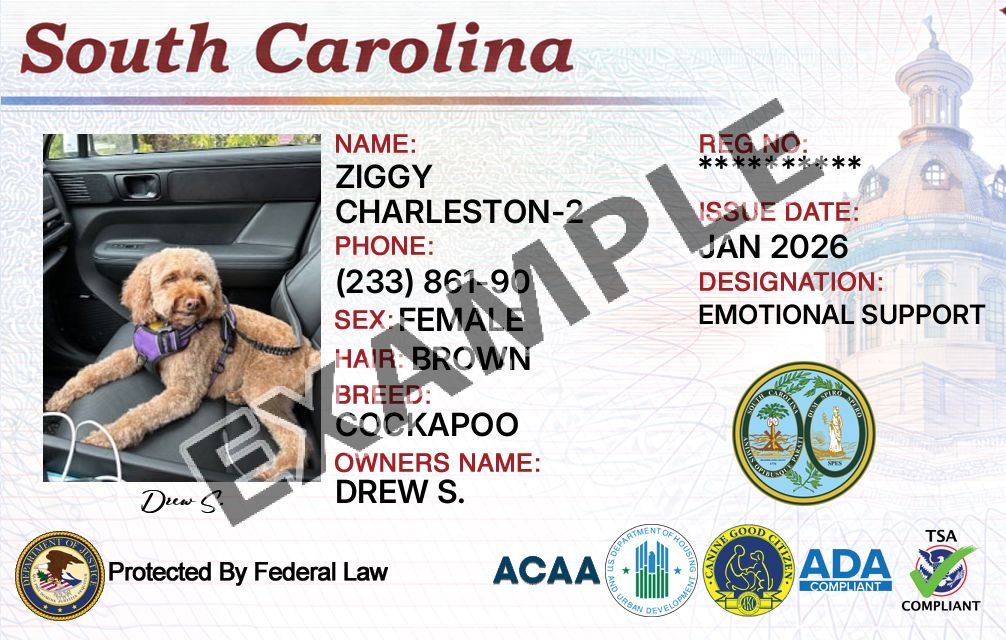
Service Dogs and Emotional Support Animals in Cherokee, South Carolina
If you’re searching where do I register my dog in Cherokee County, South Carolina for my service dog or emotional support dog, the key is to separate three different things that often get mixed together: (1) local dog licensing (when required), (2) rabies vaccination and rabies tag requirements, and (3) a dog’s status as a service dog or an emotional support animal (ESA).
In Cherokee County, most “registration” questions are handled locally through county animal control and related local government offices. Rabies vaccination and rabies tags are governed at the state level, but enforcement and day-to-day guidance often happen through local agencies. This page explains how a dog license in Cherokee County, South Carolina typically works, who to contact for an animal control dog license Cherokee County, South Carolina question, and where to register a dog in Cherokee County, South Carolina without relying on third-party services.
Where to Register or License Your Dog in Cherokee County, South Carolina
Because licensing and enforcement are usually handled at the county or municipal level, start with the official offices below. These examples are within Cherokee County, South Carolina and are commonly involved with animal control, stray/lost animal intake, and rabies-related enforcement questions. If you live inside a town or city limit, you may have additional local rules—confirm with the office that serves your address.
Cherokee County Animal Control (Sheriff’s Office Division)
- Address: 312 E. Frederick St.
- City/State/ZIP: Gaffney, SC 29340
- Phone: (864) 487-8529
- Hours: Monday–Friday, 7:30 a.m. to 4:00 p.m.
- Email: Not listed
Cherokee County Animal Shelter
- Street address: Not listed
- City/State/ZIP: Not listed
- Phone: Not listed
- Email: Not listed
- Hours: Not listed
Cherokee County Public Health Department (State Public Health Office in Cherokee County)
- Address: 400 S Logan St
- City/State/ZIP: Gaffney, SC 29341
- Phone: (864) 487-2705
- Email: info@dhec.sc.gov
- Hours: Not listed
Cherokee County Sheriff’s Office (Main Office)
- Address: 312 E. Frederick Street
- City/State/ZIP: Gaffney, SC 29340
- Phone: (864) 489-4722
- Email: Not listed
- Hours: Not listed
Overview of Dog Licensing in Cherokee County, South Carolina
Dog licensing vs. rabies tags: what people mean by “registration”
When residents ask for “registration,” they may mean one of the following:
- Dog license (local): A county or city-issued license (often an annual requirement where adopted by ordinance). The process and fees are local and can vary by address.
- Rabies vaccination certificate and rabies tag (state-regulated): In South Carolina, dogs are required to be vaccinated against rabies, and vaccination typically results in a rabies certificate and a tag.
- Service dog / ESA documentation (not the same as a license): A service dog’s legitimacy is based on disability-related training and legal definitions; an ESA is based on a disability-related need supported by a healthcare provider, mainly for certain housing situations.
Primary local agencies you’ll deal with in Cherokee County
Cherokee County Animal Control is a division of the Cherokee County Sheriff’s Office and is responsible for investigating nuisance animal issues and enforcing county animal-related ordinances. If you need to confirm what counts as compliance for your household (including questions tied to a dog license in Cherokee County, South Carolina or rabies proof for your dog), Animal Control is typically the most direct starting point for county-level guidance.
Rabies vaccination requirements in South Carolina (why it matters for licensing)
Rabies vaccination is a foundational requirement for responsible dog ownership in South Carolina. When your dog is vaccinated, you generally receive a rabies vaccination certificate and a rabies tag for the collar. Keep that certificate in a safe place and store a photo copy on your phone; it is commonly requested when dealing with animal control, boarding, grooming, travel, or housing requirements.
In Cherokee County materials summarizing local animal rules, the county references rabies inoculation requirements and identifies Animal Control (Sheriff’s Office division) as the relevant enforcement contact point for animal-related ordinance issues.
How Dog Licensing Works Locally in Cherokee County, South Carolina
Step-by-step: how to find the correct licensing path for your address
Cherokee County residents often fall into one of two categories:
- Unincorporated Cherokee County (county jurisdiction): You will generally work with Cherokee County Animal Control (Sheriff’s Office division) for guidance on county rules, enforcement, and what documentation is expected.
- Inside a city/town limit (municipal jurisdiction): A city or town may have additional requirements or enforcement procedures. Even then, the county can still be involved depending on the issue (stray pickup, bite investigations, rabies control coordination, etc.).
The fastest way to confirm where to register a dog in Cherokee County, South Carolina is to call the county Animal Control office and ask:
- Whether your address is served primarily by county Animal Control or a municipal department
- Whether Cherokee County issues a local dog license/tag or relies on rabies tags as the primary “tag” requirement
- What proof they require (rabies certificate, residency, identification, etc.)
- Where payments or forms are handled (in person, by mail, or through another official office)
What enforcement and compliance typically focus on
Local enforcement and compliance efforts usually focus on public safety and disease prevention. In practical terms, that often means:
- Current rabies vaccination (and the ability to prove it quickly)
- Leash/control rules (preventing roaming dogs and nuisance conditions)
- Stray/lost dog handling (holding and return-to-owner processes)
- Bite incidents (documentation, quarantine rules, and public health coordination)
Special note for service dogs and ESAs
Even if your dog is a service dog or emotional support animal, you should expect to follow the same public health rules that apply to other dogs—especially rabies vaccination requirements. A service dog’s public access rights come from disability law, not from buying a vest, paying a registry fee, or obtaining an online certificate.
Service Dog Laws in Cherokee County, South Carolina
What makes a dog a “service dog”
A service dog is generally a dog that is individually trained to do work or perform tasks for a person with a disability. The tasks must be directly related to the person’s disability (for example, guiding, alerting, retrieving, interrupting a medical episode, or providing mobility support).
Do you need to “register” a service dog with Cherokee County?
In most everyday scenarios, you do not need a special “service dog registration” from a private registry to have a legitimate service dog. However, local requirements such as rabies vaccination and any applicable local animal control dog license Cherokee County, South Carolina processes can still apply. If an office offers an optional local tag or record, treat it as administrative convenience—not the legal source of service-dog status.
Public access: what businesses can ask
If you bring a service dog into public places where pets normally aren’t allowed, staff typically may ask limited questions focused on whether the dog is required because of a disability and what work or tasks the dog is trained to perform. They should not require you to show an ID card from an online registry. Regardless, service dogs still must be under control and housebroken.
Emotional Support Animal Rules in Cherokee County, South Carolina
How an emotional support animal (ESA) is different from a service dog
An emotional support animal provides comfort by its presence, but it is not the same as a service dog because an ESA is not required to be trained to perform specific disability-related tasks. This difference affects where the animal is allowed and what rights apply.
Housing vs. public places
ESAs are most commonly recognized in housing contexts (for example, requesting a reasonable accommodation to live with the animal under a lease or “no pets” policy when appropriate). ESAs generally do not have the same public access rights as service dogs in stores, restaurants, or other public accommodations.
Does an ESA need a dog license in Cherokee County, South Carolina?
If your address falls under a local licensing system, an ESA is still a dog for licensing and rabies purposes. In other words: ESA status does not replace compliance with local animal rules. If you’re unsure what applies, contact county Animal Control and ask specifically about local requirements for your address and whether your documentation should include rabies proof and any local license/tag information.
Frequently Asked Questions
Disclaimer
Licensing requirements and office locations may change. Residents should verify details with their local animal services office within Cherokee County, South Carolina.
What You May Need
- rabies vaccination proof
- identification
- proof of residency
- licensing fee
Quick checklist for calls
- Your physical address (to confirm jurisdiction)
- Your dog’s rabies vaccination date and certificate info
- Whether your dog is a pet, service dog, or ESA (for context)
- Any prior license/tag numbers (if applicable)
Reminder about common confusion
“Registering” a service dog online does not replace local rules. If your goal is compliance in Cherokee County, focus on rabies proof, local requirements for a dog license (if applicable), and keeping your dog under control in public.
Register A Dog In Other South Carolina Counties
Select your county below to get started with your dog’s ID card. Requirements and license designs may vary by county, so choose your location to see the correct options and complete your pup’s registration.
- Abbeville County Dog Registration
- Aiken County Dog Registration
- Allendale County Dog Registration
- Anderson County Dog Registration
- Bamberg County Dog Registration
- Barnwell County Dog Registration
- Beaufort County Dog Registration
- Berkeley County Dog Registration
- Calhoun County Dog Registration
- Charleston County Dog Registration
- Chester County Dog Registration
- Chesterfield County Dog Registration
- Clarendon County Dog Registration
- Colleton County Dog Registration
- Darlington County Dog Registration
- Dillon County Dog Registration
- Dorchester County Dog Registration
- Edgefield County Dog Registration
- Fairfield County Dog Registration
- Florence County Dog Registration
- Georgetown County Dog Registration
- Greenville County Dog Registration
- Greenwood County Dog Registration
- Hampton County Dog Registration
- Horry County Dog Registration
- Jasper County Dog Registration
- Kershaw County Dog Registration
- Lancaster County Dog Registration
- Laurens County Dog Registration
- Lee County Dog Registration
- Lexington County Dog Registration
- Marion County Dog Registration
- Marlboro County Dog Registration
- McCormick County Dog Registration
- Newberry County Dog Registration
- Oconee County Dog Registration
- Orangeburg County Dog Registration
- Pickens County Dog Registration
- Richland County Dog Registration
- Saluda County Dog Registration
- Spartanburg County Dog Registration
- Sumter County Dog Registration
- Union County Dog Registration
- Williamsburg County Dog Registration
- York County Dog Registration